

The Six Decision-Making Styles Every Leader Should Know
A practical framework for balancing authority, collaboration, and trust.
Read time: 14 minutes
Your employees want clarity. They want to know whether they're making the decision, influencing the decision, or simply being informed of it. Most people are comfortable with any of those options, as long as they understand their role and trust that there is an appropriate balance between their manager making decisions and their team having meaningful input.
Here's the reality: most of us wouldn't want to work for a manager who never made decisions independently. It would slow everything down. At the same time, we also wouldn't want to work in an environment where employees have little opportunity to influence the decisions that affect their work.
The challenge is that many managers and teams lack a shared language for discussing the different ways decisions can be made.
This article is designed to help managers create that common language. By understanding the full range of decision-making approaches, leaders can intentionally strike the right balance between exercising their authority and inviting meaningful involvement from their teams.
What the Research (and Our Experience) Tells Us
Research consistently shows that employees want to feel involved. Mind blown, right?
A classic study by Ken Kovach (replicated by others) found a significant gap between what employees value and what managers think they value. Notice where "a sense of being in on things" ranked on the managers' list.
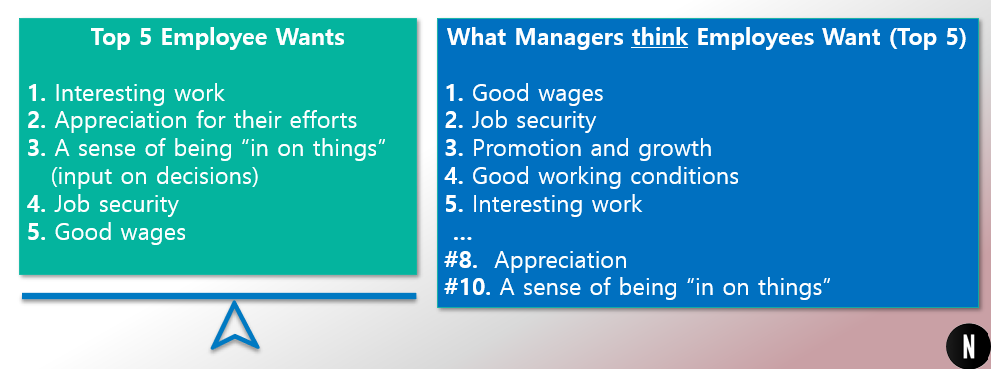
Similarly, author John Izzo found that the number one reason employees don't take more initiative at work is that their leaders fail to seek their input before making decisions.
The message is clear: people want opportunities to influence the decisions that affect their work.
But that's only half the story. Leaders can also swing too far in the other direction.
One of our consultants once observed a team spend 22 minutes deciding whether they needed a new drain stopper for the kitchen sink, and who would go buy it. The consultant joked that they could have driven to the store, bought the drain stopper, and returned before the team finished discussing it.
It's an extreme example, but it illustrates an important point. Not every decision needs broad discussion or consensus. Teams have limited time and mental bandwidth, and involving everyone in every decision can become just as frustrating as involving no one at all.
The goal isn't maximum participation. It's choosing the right decision-making approach for the situation.
The Six Decision-Making Styles
In our Managing with Mind & Heart leadership workshops, we teach six decision-making styles. In the first three, the leader retains the final decision while varying the degree of team involvement. In the last three, the leader either empowers the group to make the decision together or delegates the decision to an individual.
The real value of these styles is that they create clarity. They give teams a shared language so a leader can simply say, "This is a Style 3 decision," and everyone understands their role and what to expect.
Here are the six styles:
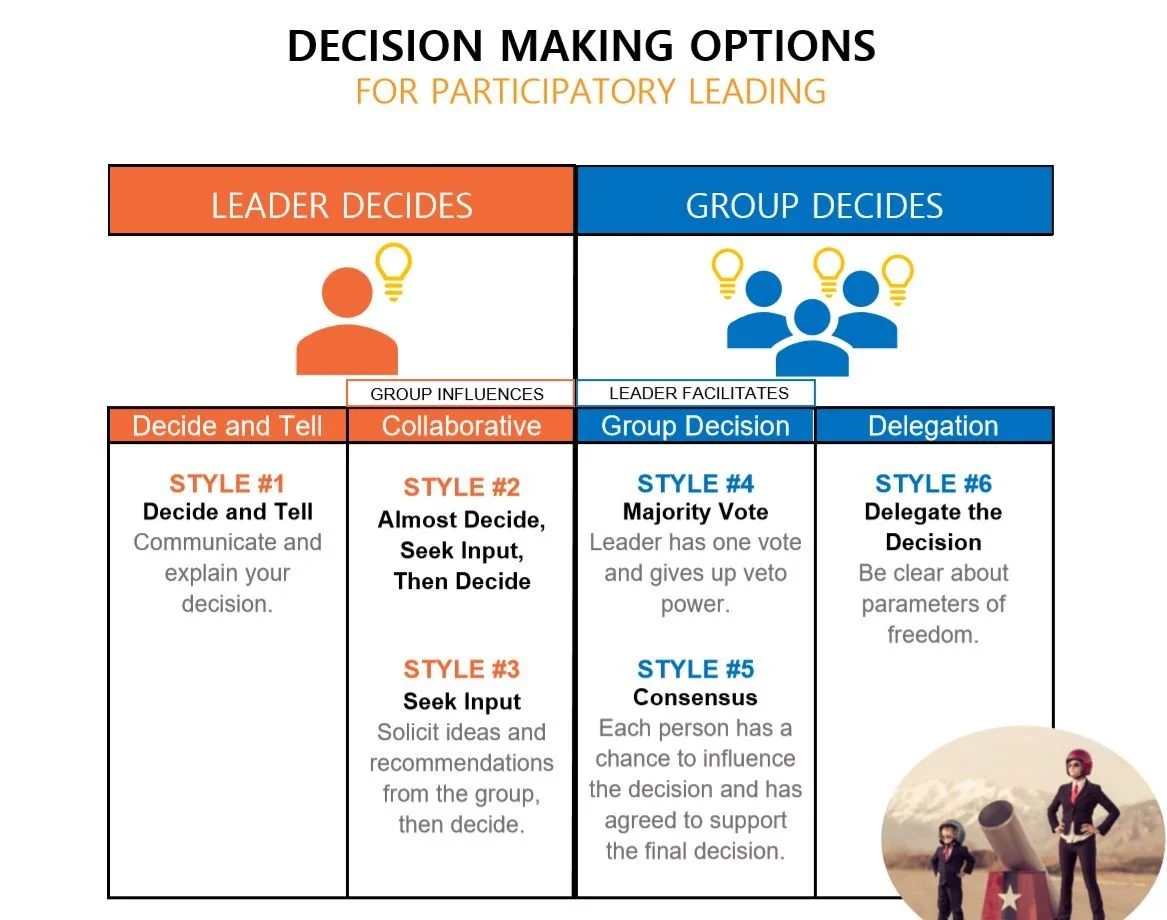
Understanding the Six Decision-Making Styles
Let's unpack each style.
Style 1: Decide and Tell
Communicate and explain your decision.
In this style, the leader makes the decision and then communicates it to the team.
"I've hired this person." "I've created a new policy." "The meeting will be in Conference Room B." "I'm creating a project workgroup." "I've decided we need to shorten our meetings."
You get the idea.
There is absolutely nothing wrong with managers making decisions on their own. In fact, many decisions should be made this way. Asking for input on every decision—or handing every decision off to employees—isn't an effective leadership strategy. However, relying on this approach for most decisions can lead to resentment, apathy, and missed opportunities for better solutions.
Style 0: Decide...then forget to tell.
In our experience, the biggest problem isn't that leaders use Style 1. It's that they make the decision and forget to communicate it. Employees are left wondering what happened, why the decision was made, or whether a decision was ever made at all.
Don't do this, OK?
Style 2: Almost decide, seek input, then decide
The leader decides. The group influences.
This is a legitimate, semi-collaborative decision-making style that is useful in many situations. The leader is leaning toward a decision but intentionally seeks input before making the final call.
"I'm leaning toward hiring this person. What do you think?" "I've drafted a new policy. Please read it and give me your feedback before I finalize it." "I think we need to shorten our meetings, but is there anything I might be missing?"
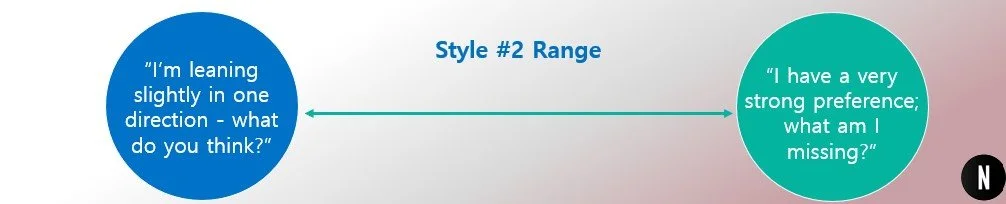
Warning! Don't disguise a Style 1 decision as a Style 2 decision. If you've already made up your mind and aren't genuinely open to feedback, don't pretend that you are. People usually figure it out, and every time they do, trust takes a hit.
Style 3: Seek input, then decide
The leader decides. The group influences.
Style 3 is similar to Style 2, but with one important difference: you begin by gathering information and input before you've formed a preferred solution.
Instead of asking, "Here's what I'm thinking. What do you think?" you're asking, "Help me understand the situation before I decide."
"Let's form an interview team. After the interviews, let me know what you think, and I'll make the final hiring decision." "I need to create a new policy. Before I draft anything, I'd like to hear your ideas and concerns." "I'm meeting with the manager of another department to address some ongoing challenges. What issues are you seeing, and what ideas do you have for improving the situation?"
Why Styles 2 and 3 are so useful: Both are collaborative without being consensus. The team has meaningful influence, but the leader retains the responsibility for making the final decision. When you're unsure which style to use, these are often safe choices because you gain valuable input without giving up decision-making authority.
Warning! This is where language really matters. Imagine you begin a meeting by saying, "We need to decide on our new policy today." What does that imply? It sounds like the group will be making the decision together.
The discussion is great. Everyone shares ideas. Then you wrap up by saying, "Thanks for all the input. I'll think it over and decide what we're going to do."
Wait...what?
Who was making the decision? You were. Who was influencing the decision? The group.
Clarity matters. When expectations don't match reality, people feel misled. This is another reason a shared decision-making vocabulary is so valuable. You can simply say, "This is a Style 3 decision." Everyone immediately knows that the leader will make the final decision after hearing the group's input.
Style 4: Majority Vote
The group decides. The leader participates.
This style can come in handy for the "pepperoni or sausage?" decisions, as well as decisions about events, the physical work environment, dates and times, and much more. It's generally quick and painless, as long as you're not using it for high-impact decisions where a simple majority isn't the right approach.
It can also be a helpful fallback when a Style 5 decision reaches a stalemate.
Style 5: Consensus
The group decides. The leader participates.
"Ugh...consensus? Yuck."
That's not an uncommon reaction. Many people have had bad experiences with consensus. Decisions take forever. Nothing gets decided. The leader gets frustrated and quietly changes the decision-making style. Or the group reaches a decision that no one is actually happy with.
In our view, the problem with consensus is a lack of understanding about how to do consensus well. When everyone shares a common understanding of what consensus means and the role they play, it becomes a powerful way to build trust, strengthen collaboration, and create genuine ownership of important decisions.
For example, consensus can be a great choice when deciding:
Which finalist to hire after interviews.
How your staff meetings will be organized and facilitated.
Your team's shared values or commitments.
For consensus to work, everyone on the team needs to understand its definition and three key principles:
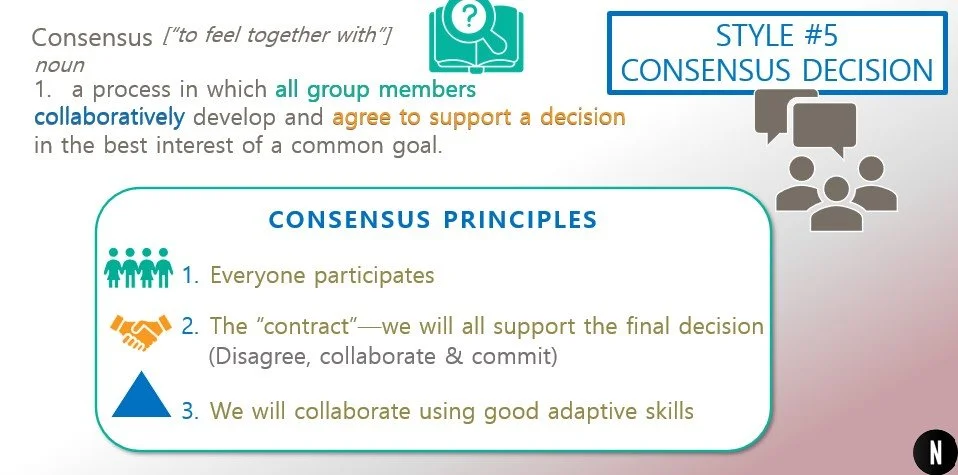
Notice what this definition doesn't say. It doesn't say everyone gets their way. It says everyone collaborates to develop a decision—and agrees to support it—in the best interest of the team's shared goal.
The third principle deserves a little more attention. What do we mean by good adaptive skills?
For example:
Receiving feedback with curiosity rather than defensiveness.
Giving feedback without creating defensiveness.
Seeing situations from another person's point of view.
Speaking up when you'd rather stay quiet.
Letting go of personal preferences for the good of the team.
Owning mistakes quickly and proactively.
Staying calm and engaged during emotionally charged conversations.
Consensus isn't just a meeting technique. It's a set of relationship skills. Build common commitments with your team around the behaviors everyone agrees to practice during consensus discussions.
***
One simple tool makes it much easier to determine whether the group has actually reached consensus.
Imagine you've spent an hour discussing an important issue: brainstorming, working in small groups, and refining ideas. It feels like the group is close to a decision. So, you ask everyone: "If this were our decision, where are you? Hold up one to five fingers."
Here is what each number means:
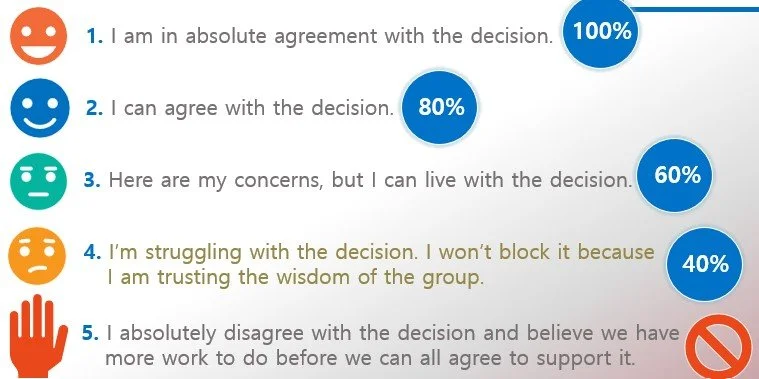
Here's the biggest misconception about consensus: It does not mean everyone agrees with every part of the decision. It means everyone can genuinely support the decision, even if it isn't exactly what they would have chosen.
So, if you look around the room and see several people holding up ones, a few with twos, and several with threes and fours…guess what? You've technically reached consensus!
That said, just because you've reached consensus doesn't mean you have to stop there. Sometimes it's worth continuing the conversation to see if you can move more people toward a one or two.
We once consulted with a Lutheran art guild (who hasn't, right?) that was developing its mission statement and values. By the end of the first day, the group had reached consensus. But they had another full day together, so they decided to keep working. By the end of the second day, everyone was holding up a one or two.
Bottom line: Consensus is powerful. It's also expensive; it takes time and energy. Spend it on the decisions that are worth the investment.
Style 6: Delegate the Decision
Others decide.
Is there an ad hoc work group that can take on this decision? Are there one or two employees with more expertise than you have in this area? Should the interview team be empowered to choose the finalist on its own?
In a Style 6 decision, your job is to provide clear parameters, any needed resources or guidance, and then, well, get out of the way.
Warning! Delegation isn't abdication. Be clear about the desired outcome, any constraints or boundaries, and the level of authority you're giving. Once you've done that, trust people to make the decision.
Wrap Up
Over the past decades, we've seen hundreds of leaders and teams benefit from creating a shared language around these six decision-making styles.
Notice the progression:
Style 1: I decide.
Style 2: I have a direction and seek input before deciding.
Style 3: I gather input before deciding.
Style 4: We vote.
Style 5: We decide together.
Style 6: You decide.
The goal isn't to use one style more than another. It's about intentionally choosing the style that best fits the situation and clearly communicating that choice so everyone understands their role. When people know whether they're deciding, influencing, or simply being informed, confusion decreases and trust grows.
People don't expect to make every decision. They do expect to understand how decisions will be made.