

Manager Responses to Employee Concerns
Does the following situation sound familiar to you?
Employee: “Do you have a minute?”
You can feel it already. This isn’t about a stapler order.
It’s about a coworker. Or a supervisor. Or something that “isn’t technically wrong” but doesn’t feel right.
In that moment, every manager faces the same quiet pressure: What do I do with this?
Do I act?
Do I stay out of it?
Do I advise?
Do I escalate?
Do I ignore it?
Here’s the part we don’t talk about enough:
If you don’t have a consistent framework, your response will depend on your mood, your stress level, your personal biases…or whether you’ve eaten lunch yet.
That’s where fairness breaks down.
Managing for Fairness
One of the most important skills a manager can develop is the ability to respond consistently and equitably.
Fairness isn’t about treating everyone identically. It’s about applying the same decision logic every time.
When leaders respond to similar concerns differently — based on who brought it, how much they like the person, how loud the complaint is, or how tired they are — trust erodes.
That’s why frameworks matter. They help counteract our unconscious (or conscious!) biases.
In fact, being fair and equitable is one of the Top 15 Management Skills that we train people-leaders on in our Managing with Mind & Heart workshop series. And you cannot be consistently fair without a consistent method.
The good news? When it comes to employee concerns, you don’t have 50 options. You have five.
But before we get there, you need to ask yourself two questions.
The Two Questions That Drive Your Responses
Whenever an employee brings you a concern, run it through two filters.
1. The Employee Impact Question (EIQ)
In your judgment, does the issue being reported to you actually impact this employee’s ability to do their job?
Not: “Are they bothered?”
Not: “Are they annoyed?”
Does it in a practical, tangible way impair their performance Productivity? Psychological (or physical) safety?
Real life example #1: “Jan has been over there looking out the window, not working, for 10 minutes!”
OK, let’s practice. Is this a “yes” or a “no” on the EIQ?
Unless this employee and Jan are supposed to be performing brain surgery together right this moment (or similar!), the answer is most likely a resounding “no.”
That’s the first filter.
2. The Organizational Impact Question (OIQ)
Now we zoom out.
Does this behavior impact (or potentially impact) the health and functioning of the organization?
Does this particular concern negatively affect:
Customers?
Legal exposure?
Ethical standards?
Team morale?
Operational accuracy?
The reputation of the organization?
Back to our example: “Jan has been over there looking out the window, not working, for 10 minutes!”
“Yes” or “no” on the OIQ?
Again, a big “no,” right? What you didn’t hear was “Jan looks out the window, not working, for 10 minutes every 20 minutes.” Now, in that case, it might actually have an impact on the organization.
***
Notice something important: At this stage, you do not need to determine whether the complaint is fully accurate. (More on this later!)
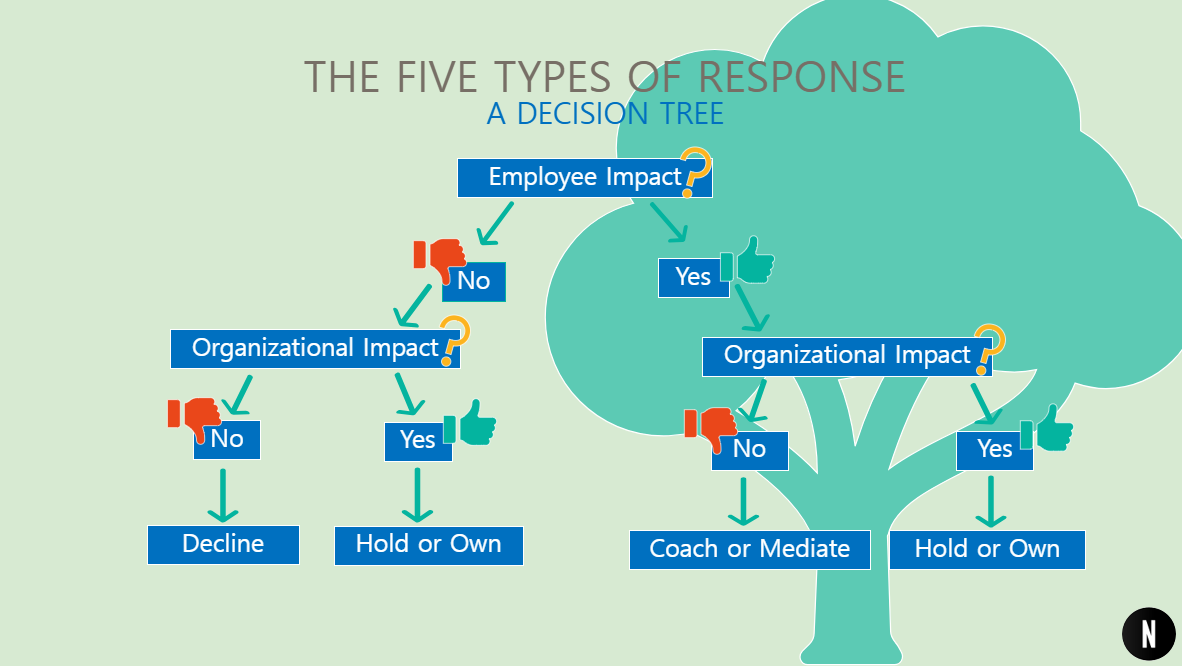
Once you answer those two questions, your response falls into one of five categories.
The Five Types of Employee Responses
1. Decline: No Action
(EIQ: No | OIQ: No)
Sometimes the right answer is, “I’m not going to do anything about this, and here’s why.”
This is appropriate when:
The behavior does not impact the employee’s ability to perform.
It does not impact the organization.
That doesn’t mean the employee is silly. It doesn’t mean you rudely dismiss them. Often, they just need to be heard. You might ask, “Help me understand why Jan’s 10-minute break feels like a problem for you.”
And sometimes this becomes a growth moment.
Stephen Covey’s “Circle of Concern vs. Circle of Influence” is helpful here. Not everything that concerns us is within our influence (nor does it need our influence). Part of leadership is helping employees develop adaptive skills — including letting go of what we cannot or should not control. Certainly, there are behaviors from others that are annoying and frustrating. But we don’t have an infinite amount of energy, so the growth opportunity here is to learn to spend it wisely.
Decline is not avoidance. It is clarity.
2. Coach: Advised Action
(EIQ: Yes | OIQ: No)
Here, the issue genuinely affects the employee’s ability to do their job. But it does not rise to the level of organizational impact.
Your message becomes, “I’m not going to act directly, but I can help you address this.”
Real life example #2: “Keira tends to play her music too loud in his office, and it makes it hard for me to concentrate.”
And you say….?
Answer: “And what did Keira say when you asked her to turn down her music?”
This is where managers can often either over-function or under-function:
Over-functioning: You step in and solve it for them.
Under-functioning: You say, “Not my problem.”
Coaching is the middle ground.
You might:
Help them understand how your direct involvement could create new issues
Help them script a feedback conversation.
Role-play the interaction.
Brainstorm solutions.
Offer to have another conversation after they attempt to address it themselves.
This builds capability instead of dependency.
Basically, with this response, you are communicating that you understand why the issue is negatively impacting their ability to do their job, but that this situation will best be addressed directly, between the employee and the Keira.
But remember: if the OIQ becomes “yes,” (for example, Keira refuses to change her behavior or gets aggressive), you are no longer going to stick with Option 2 (coach). You are obligated to act directly.
3. Mediate: Shared Action
(EIQ: Yes | OIQ: Yes or No)
This is often relational conflict. The type where it might not have an organizational impact right now, but it could if it doesn’t get resolved.
Two employees in ongoing tension. A team struggling with behavioral norms. People disagreeing on a shared process, and you want them to solve it together.
Your message: “I want to get you together and help you work this out.”
Notice the nuance. You are not solving it for them. You are creating a structured container where they solve it.
Here’s a helpful analogy: In Option 2 (Coach), you coach the player on the sidelines – you don’t cross the sideline and enter into the game itself. In Option 3 (Mediate), you’re more like the referee – you’re on the field, but you’re still not playing the game.
Bottom line: They work it out, and you facilitate them getting there.
4. Hold: Potential Action
(EIQ: Yes or No | OIQ: Yes)
Hint: If the OIQ answer is “yes,” you are obligated to choose Option 4 or Option 5.
Sometimes the issue is legitimate…but early.
Your message: “I’ve got this. I’m going to pay attention, and I’ll address it if it continues.”
This is watchful waiting. You are not intervening yet – but you are consciously choosing to monitor for the possibility of it becoming a true organizational issue.
Examples:
A one-off behavior that may become disruptive if it continues.
A pattern that hasn’t fully formed.
Hold prevents overreaction. Not every organizational concern requires immediate intervention. But it does require attention.
Note: This isn’t the same thing as you needing to “look into” the situation or go collect more information. This is literally a situation in which you are not going to act unless the behavior/issue continues.
5. Own: Take Action
(EIQ: Yes or No | OIQ: Yes — serious, systemic, or high-risk)
Your message: “I’ve got this,” or “I’ll look into this.”
Bottom line: These are areas that you, as a leader in the organization, are required to deal with, or at least look into.
Examples:
Unclear roles, tasks, or priorities
Employees failing to meet job expectations (tardiness, inaccurate work, etc.)
Workplace violence, harassment, or other legal or ethical violations
Ongoing disruptive behavior
This may involve:
Policy enforcement or setting clear expectations
Direct feedback and coaching
Corrective action and/or other HR involvement
This is leadership accountability.
The Decision Tree (Simplified)
Two Principles That Prevent Most Missteps
1. Tell the Employee Which Option You’re Choosing
Ambiguity erodes trust. If you’re declining, say so. If you’re holding, say so. If you’re coaching, say so (probably in a more tactful way than “I’m going to coach you!”).
Clarity feels kind, even when the answer is “no.”
2. You Don’t Need Full Proof to Categorize
The ultimate veracity of what the employee is saying is not relevant to your initial decision. Your initial response should be based on the complaint as presented, regardless of what actually occurred. In other words, the choice you make is immediate, not after verifying the complaint's legitimacy.
Remember, if you do feel the need to verify what they are saying, you’ve chosen response #5, because “investigating” the complaint is a form of taking ownership.
When the Formula Isn't Enough
Sometimes a complaint doesn’t fit neatly. Frameworks guide you, but they don’t replace judgment. Leadership still requires discernment and reading into the context. But having a structure keeps you from reacting emotionally or inconsistently. And that’s the heart of fairness.
Leadership Is Choosing on Purpose
Every concern requires a choice.
Doing nothing is a choice. Owning is a choice. Coaching is a choice. The question is whether your choices are consistent.
So reflect:
Where do I tend to over-own?
Where do I decline too quickly?
Do I coach enough?
Do I hold concerns I shouldn’t be holding?
Am I fair in my responses?
When managers respond intentionally and consistently, trust grows. And when trust grows, engagement strengthens.
***
Further below, you’ll find several short case studies to put this new tool to the test. As you read through them, pause and decide: Which response would I choose? Why?
Also, we did a podcast episode on this topic that goes into the nuances. You should definitely give it a listen. Come on, you know you want to.
⬇️ Keep scrolling for more good stuff…
Case Studies: Put the Manager Response Framework to the Test
***
As you read each scenario, ask yourself:
What is the actual behavior?
What’s the EIQ?
What’s the OIQ?
Which of the five responses fits — Decline, Coach, Mediate, Hold, or Own?
Once you’ve worked through them, scroll down to see how we would categorize each one.
Case Study 1
“When you’re not around, he’s rude to us. He yells. Yesterday he got mad and knocked my phone out of my hand.”
Case Study 2
“They ignore me when I say good morning, badmouth me to others and respond rudely. It’s causing me a lot of stress at work.”
Case Study 3
“They unfriended me on Facebook.”
Case Study 4
“He’s badmouthing the organization online.”
Case Study 5
“My supervisors are incompetent. One tells me to do it this way, and the other tells me to do it differently. It’s confusing.”
Case Study 6
“She’s super careless and doesn’t care about details. I’ve noticed she’s not billing our customers correctly.”
Case Study 7
“He keeps commenting on my looks.”
Case Study 8
“She’s often 15 to 20 minutes late.”
Backstory: The late person is an hourly employee. The person complaining isn’t impacted by the tardiness at all.
Case Answer Cheat Sheet
Remember: You are categorizing impact first — not determining guilt. And context always matters.
Case Study 1
Primary Behavior: Potential workplace violence
EIQ: Yes
OIQ: Yes
Response: OWN
This rises immediately to organizational and safety risk.
Even if the details later shift (e.g., accidental contact), the initial categorization remains Own due to severity.
HR involvement? Yes.
Case Study 2
Primary Behavior: Relational conflict
EIQ: Yes
OIQ: Not necessarily — at least initially
Recommended Progression:
COACH – Help the employee address it directly.
If unresolved → MEDIATE – Facilitate a structured conversation.
If it becomes ongoing and disruptive → OWN
This is a progression scenario. Jumping straight to Own would likely be over-functioning.
Case Study 3
Primary Behavior: Personal social media boundary
EIQ: No
OIQ: No
Recommended Response: DECLINE
This does not impact job performance or organizational health.
You may:
Acknowledge feelings.
Explore why it feels personal.
But this is not a management action issue. This is a Circle of Concern conversation.
Case Study 4
Primary Behavior: Public disparagement
EIQ: Likely no
OIQ: Possibly yes
Recommended Response: HOLD or OWN (Context Dependent)
If vague or mild comments → HOLD (monitor)
If policy violation or clear reputational harm → OWN
Case Study 5
Primary Behavior: Conflicting direction / structural misalignment
EIQ: Yes
OIQ: Yes
Recommended Response: OWN (Usually)
This is typically an organizational clarity issue — not just a personality problem.
Occasional nuance:
If the employee hasn’t sought clarification themselves, there may be some Coaching involved, but most often this is structural ownership.
Case Study 6
Primary Behavior: Accuracy / financial risk
EIQ: No
OIQ: Yes
Recommended Response: OWN
Case Study 7
Primary Behavior: Sexual harassment
EIQ: Yes
OIQ: Yes
Legal Risk: Yes
Recommended Response: OWN
This is not a Coach or Mediate scenario.
HR involvement? Yes.
Case Study 8
Context: The late employee is hourly. The reporting employee is not impacted.
EIQ: No
OIQ: Yes
Recommended Response: HOLD or OWN
Additional Context: Let’s say the employee has an approved accommodation. Now your response shifts to improving communication.